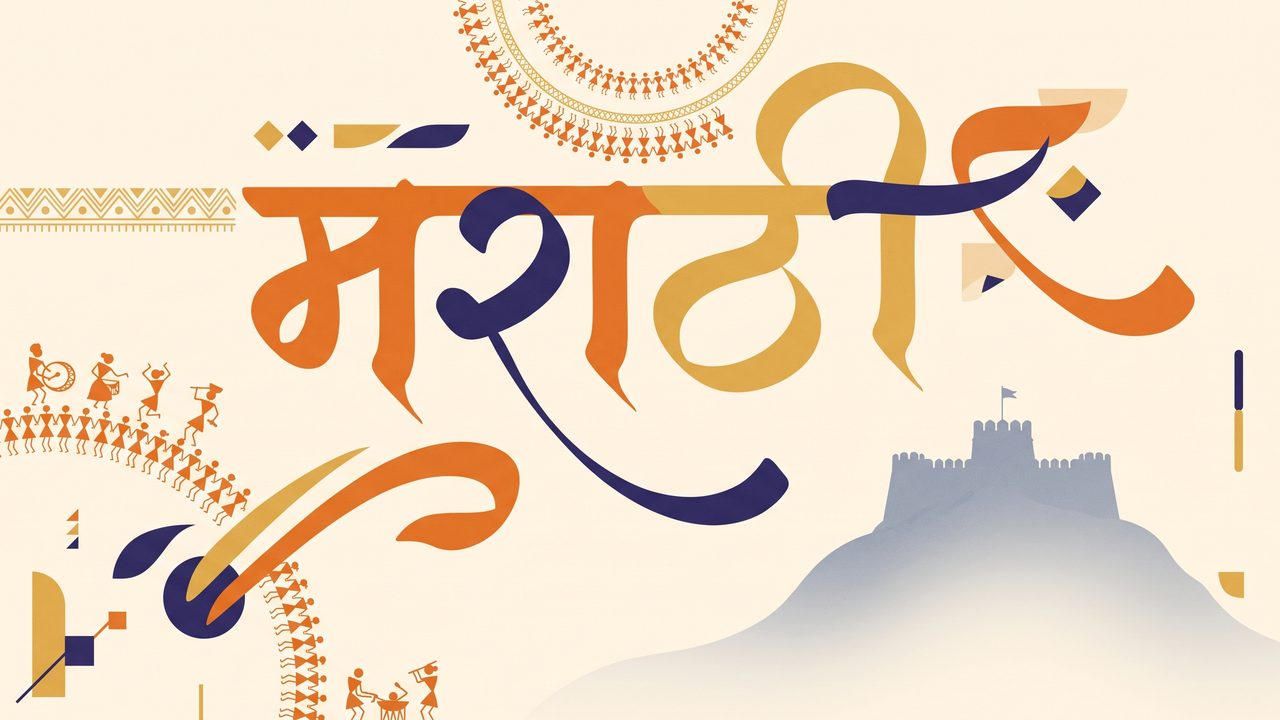
Marathi is one of the world\'s great languages — ancient, literary, and vigorously alive. Spoken by over 83 million people, it is the official language of Maharashtra and the third-most-spoken language in India. Yet even among learners who study Marathi grammar diligently, many do not know the full story of the language they are learning: its age, its scientific contributions, its literary giants, its unique grammatical features, and its place in global culture.
This article presents 15 verified, genuinely fascinating facts about the Marathi language — the kind of background knowledge that transforms language study from a technical exercise into a connection with history and culture. Each fact is explained with enough depth to be truly illuminating, not just a trivia bullet point. You will find linguistic insights, historical context, cultural connections, and practical takeaways for your learning journey.
Pair your reading of this article with the Marathi Alphabet lesson to understand the script history mentioned below, and check today\'s Daily Word to encounter the language in use after learning about its background.
Facts 1–3: Age, Origin, and Script
Fact 1: Marathi Is Over 2,000 Years Old
The earliest identifiable ancestors of Marathi appear in Pali and Apabhramsha texts from around the 2nd century BCE. The language descended from Maharashtri Prakrit, a literary form of Prakrit used widely across ancient India for poetry and drama. Maharashtri Prakrit was so prestigious that it was used in literary works by authors from regions far beyond Maharashtra.
The first clearly recognisable Marathi inscription dates from 1012 CE — a copper-plate grant from the Shilahara dynasty discovered in Satara district. By the 13th century, Marathi had a mature literary tradition with sophisticated poetry. The language you are learning today has a literary pedigree spanning more than two millennia.
Fact 2: Marathi Has Its Own Literary Epoch Called the Bhakti Period
Between the 13th and 17th centuries, Maharashtra produced one of the most remarkable literary movements in any language: the Warkari Bhakti movement. Poet-saints (संत) composed अभंग (abhaṅga) — devotional poems of extraordinary lyrical beauty — in the vernacular language so that spiritual wisdom could reach all people regardless of caste or education.
The major saints — Sant Dnyaneshwar (1275–1296), Sant Namdev, Sant Eknath, and Sant Tukaram — did not merely write religious verse. They shaped the Marathi literary language itself. Dnyaneshwar\'s ज्ञानेश्वरी, a Marathi commentary on the Bhagavad Gita written when he was a teenager, remains one of the most celebrated works in Marathi literature. The Proverbs lesson includes several sayings attributed to these saint-poets that are still in active daily use today.
Fact 3: Devanagari Was Designed for Multiple Languages, Not Just Sanskrit
Marathi is written in Devanagari script (देवनागरी), which it shares with Hindi, Sanskrit, Nepali, and several other languages. The script was designed as a phonologically comprehensive system capable of representing all sounds in the Indo-Aryan language family. Each character corresponds to a specific phoneme, and the script includes characters for sounds that do not exist in many other languages.
Marathi uses the full Devanagari character set plus a few conventions specific to Marathi phonology. The character ळ (ḷa — a retroflex lateral sound) is particularly associated with Marathi and distinguishes it from Hindi script usage. Mastering the Marathi Alphabet means learning not just the shared Devanagari characters but also these Marathi-specific ones.
Historical Insight
Devanagari means "divine city script" — देव (divine) + नागरी (of the city or city-dwellers). The name reflects both the sacred associations of Sanskrit (for which the script was originally refined) and its urban literary prestige.
Facts 4–6: Grammar, Structure, and Linguistic Features
Fact 4: Marathi Is a Morphologically Rich Language
Linguists classify languages by how they pack grammatical information into words. English is relatively analytic — it uses separate words for most grammatical functions ("I will have been going"). Marathi is synthetic and agglutinative — it suffixes multiple grammatical markers to a single root. A single Marathi verb form can encode tense, aspect, mood, person, number, and gender simultaneously.
For example, the word खाल्लेल्या encodes: eating (root खा), completed action (suffix -ल्ले), oblique/genitive case marking (-ल्या), and is used in expressions like खाल्लेल्या अन्नाची (of the eaten food). This morphological richness is what makes Marathi grammar both complex to learn and precise to use.
Fact 5: Marathi Has Three Grammatical Genders, Not Two
Many European languages have two grammatical genders; some have three (German, Russian). Marathi has three: masculine (पुल्लिंग), feminine (स्त्रीलिंग), and neuter (नपुंसकलिंग). Unlike in many languages where gender is relatively marginal to grammar, Marathi gender is pervasive — it affects verb endings, adjective forms, pronoun forms, and possessive suffixes.
What makes Marathi particularly interesting is that the neuter gender is extremely common for abstract and inanimate nouns, which means learners encounter all three genders constantly in everyday sentences. There is no way to avoid learning the gender system — it is central to every grammatically correct sentence.
Fact 6: Marathi Has a Formal-Informal Pronoun Distinction That English Lost
English once had a formal-informal second-person distinction (thou vs. you) but collapsed it in the 17th century. Marathi maintains the full distinction in active daily use:
- तू (tū) — informal singular "you," used with children, close friends, and subordinates
- तुम्ही (tumhī) — formal or plural "you," used with elders, strangers, and people of higher social standing
- आपण (āpaṇ) — the most formal register of "you," used in very formal or literary contexts
Using the wrong level of formality in Marathi is a real social error, not just a stylistic one. Native speakers notice and react to pronoun register choices immediately. For learners, the safest strategy is to default to तुम्ही with everyone until you know the person well enough to judge the appropriate register.
तू कुठे जातोस? (मित्राला) — तुम्ही कुठे जाता? (वडिलांना) — आपण कुठे जाता? (अतिशय आदरार्थी)
Where are you going? (to a friend) — Where are you going? (to a parent) — Where are you going? (highly formal/honorific)
Facts 7–9: Literature, Proverbs, and Cultural Expressions
Fact 7: Marathi Has a Rich Proverb Tradition That Encodes Social Wisdom
Marathi म्हणी (mhaṇī — proverbs) are not merely colourful sayings. They are compact encodings of social observation and practical wisdom, often rooted in agricultural life, family relationships, and the moral philosophy of the Bhakti saints. Many are still in active conversational use today, used naturally in speech and writing by Marathi speakers of all ages.
जे नाही आपणासी, ते नको दुसऱ्यासी.
Do not do to others what you would not want for yourself. (A Marathi proverb from Sant Tukaram\'s philosophy)
The Proverbs lesson presents over 50 commonly used Marathi proverbs with their literal translations, contextual meanings, and usage examples. Learning proverbs is one of the fastest ways to sound natural in Marathi — and to demonstrate cultural literacy that delights native speakers.
Fact 8: Marathi Literature Includes a Nobel-adjacent Literary Giant
V.S. Khandekar (Vishnu Sakharam Khandekar) is one of the most decorated authors in the history of Indian literature. His novel ययाती (Yayāti), published in 1959, is considered a masterpiece of modern Marathi literature and is one of the few Marathi works to have been translated into numerous Indian and international languages. Khandekar received the Jnanpith Award — India\'s highest literary honour — in 1976, one of only a handful of Marathi writers to do so.
Other Jnanpith winners writing in Marathi include V.V. Shirwadkar (known by his pen name Kusumagraj) and Vinda Karandikar. The richness of this literary tradition is one reason the Vocabulary Building lesson includes a section on literary Marathi — the language of great Marathi literature is often more precise and evocative than everyday speech, and encountering it expands a learner\'s vocabulary and grammatical range significantly.
Fact 9: Marathi Has Its Own Number System — and It Is Still Used
Marathi has its own Devanagari numeral symbols (१, २, ३, ४, ५, ६, ७, ८, ९, ०) that are distinct from the Arabic numerals used in English. In formal printed Marathi — books, legal documents, government notices — Devanagari numerals are standard. In everyday urban usage, Arabic numerals are common. A literate Marathi reader needs to be comfortable with both.
| Devanagari Numeral | Arabic Numeral | Marathi Name |
|---|---|---|
| १ | 1 | एक |
| २ | 2 | दोन |
| ३ | 3 | तीन |
| ४ | 4 | चार |
| ५ | 5 | पाच |
| ६ | 6 | सहा |
| ७ | 7 | सात |
| ८ | 8 | आठ |
| ९ | 9 | नऊ |
| ० | 0 | शून्य |
Facts 10–12: Geography, Speakers, and Global Presence
| Jnanpith Award Winner | Year | Notable Work |
|---|---|---|
| V.V. Shirwadkar (Kusumagraj) | 1987 | विशाखा (poetry collection) |
| V.S. Khandekar | 1976 | ययाती (novel) |
| Vinda Karandikar | 2003 | विरूपिका (poetry) |
| Bhalchandra Nemade | 2015 | कोसला (novel) |
Fact 10: Marathi Is Spoken Across Six Indian States
While Maharashtra is the heartland, significant Marathi-speaking communities exist in Goa (where Marathi holds co-official status in some districts), Karnataka (particularly Belgaum/Belagavi district, which has a contested Marathi-speaking population), Madhya Pradesh, Gujarat, and Andhra Pradesh. The Indian census counts Marathi speakers across these states, with the total exceeding 83 million — making Marathi the third-largest language in India by native speakers after Hindi and Bengali.
Fact 11: Marathi Has a Significant Global Diaspora
Marathi speakers have settled across the world, with notable communities in the United States, United Kingdom, Canada, Australia, and the Gulf countries. Marathi cultural organisations, मराठी मंडळे (Marathi Mandale), maintain cultural and linguistic identity in diaspora communities through festivals, drama, music, and language classes for second-generation children. The language is maintained more robustly by diaspora communities than many other Indian regional languages of comparable size.
Fact 12: Maharashtra Has the Most Newspapers Published in Any Single Indian Language
Maharashtra consistently ranks among the states with the highest readership of regional-language newspapers. Marathi newspapers like लोकसत्ता (Loksatta), महाराष्ट्र टाइम्स (Maharashtra Times), and सकाळ (Sakal) have circulations that run into the millions. This robust print culture means the Marathi written language is used daily by a vast reading public — which keeps written standards high and the written language relevant to everyday life.
Learning Tip: Use Marathi Media
Reading Marathi news articles online is one of the best intermediate-level learning activities. The vocabulary is contemporary, the grammar is standard, and the content is relevant. The Marathi Dictionary tool lets you look up unfamiliar words instantly while reading, which keeps the reading flow going without interruption.
Facts 13–15: Unique Linguistic Features
Fact 13: Marathi Has No Equivalent of the English Verb "To Have"
English speakers rely on "have" for possession, perfect tenses, and many idiomatic expressions. Marathi expresses these concepts through different grammatical structures. Possession is expressed with the postposition जवळ (near/with) or कडे (at) combined with the verb असणे (to be).
माझ्याकडे पुस्तक आहे. (literally: With-me book is.) — I have a book.
There is no word-for-word "have" here — possession is expressed through location-with-self.
This structural difference is one of the reasons English speakers find certain Marathi sentences difficult to construct initially. The Vocabulary Building lesson includes a unit specifically on possession structures that maps the Marathi approach clearly against what English learners expect.
Fact 14: Marathi Loanwords Come From an Exceptionally Diverse Range of Languages
Marathi has borrowed vocabulary from Sanskrit, Pali, Persian, Arabic, Portuguese, Kannada, Telugu, and English. The Portuguese colonial presence in Goa gave Marathi words like बाटली (bāṭlī — bottle, from Portuguese garrafa via botija), तोफ (topha — cannon, from Portuguese topo), and various culinary terms. The Persian-via-Mughal influence gave words like बाजार (bāzār — market) and दुकान (dukān — shop). Modern Marathi continues to absorb English technical vocabulary.
This etymological diversity makes Marathi vocabulary fascinating to explore. The Marathi Dictionary tool includes etymology notes for many entries, allowing you to trace the origin of words you encounter — which is both culturally interesting and a powerful memory aid.
Fact 15: Marathi Has a Living Oral Poetry Tradition Called Powada
The पोवाडा (povāḍā) is a narrative ballad form specific to Marathi culture, traditionally performed by शाहीर (shāhīr — poet-performers) to celebrate the deeds of historical heroes. The most famous povāḍās celebrate the campaigns of Chhatrapati Shivaji Maharaj and other Maratha warriors. The tradition is not merely historical — new povāḍās are composed and performed in Maharashtra today, on contemporary political and social themes.
The language of povāḍās is muscular, rhythmic, and richly imagistic. Encountering this oral tradition gives learners a sense of Marathi\'s expressive range — the same language used in formal government documents is also capable of epic narrative poetry delivered at volume to large audiences.
Cultural Context Matters
Understanding the cultural and historical context of Marathi enriches your grammar learning in ways that drills alone cannot. The Proverbs lesson and the Vocabulary Building lesson both include cultural notes alongside language instruction — use them not just for the linguistic content but for the broader understanding they give you of the language\'s character.
Key Takeaways
Marathi is a language of remarkable depth — ancient, literary, grammatically sophisticated, and culturally vibrant. Here is what to carry forward:
- Marathi is over 2,000 years old with an unbroken literary tradition including the extraordinary Bhakti poet-saints.
- The language\'s three-gender system and morphological richness make it precise and expressive.
- Pronoun register (formal vs. informal) is socially significant and must be learned, not guessed.
- Marathi has absorbed vocabulary from Sanskrit, Persian, Portuguese, and English — its word stock is a map of Maharashtra\'s history.
- The oral poetry tradition of povāḍā shows the language at its most expressive and rhythmic.
- Use the Marathi Dictionary tool to explore word origins and the Daily Word tool to encounter the language daily.
- Visit the Proverbs lesson to connect grammar learning with Marathi cultural wisdom.
- The Marathi Alphabet lesson is your gateway to the script whose history and design you now understand.
Every fact in this article is a thread that, pulled gently, leads deeper into one of India\'s most remarkable linguistic heritages. Pull the threads — learn the language.